
- Published on
Introduction AI Agent
- Authors

- Name
- Dimori
AI Agents: Definition, Trends, and Real-World Applications
As of 2026, the shift from "Generative AI" to "Agentic AI" has redefined how businesses and individuals interact with technology. Unlike traditional AI that simply generates content, AI Agents are designed to complete complex goals autonomously.
1. What is an AI Agent?
An AI Agent is a system capable of perceiving its environment, reasoning about how to achieve a specific goal, and taking actions to reach that goal. While they simulate human decision-making, they often excel in processing complex calculations and multi-step workflows at superhuman speeds.
The 4 Core Pillars of an AI Agent:
- Environment: The digital or physical space where the agent operates (e.g., websites, internal databases, APIs, social media).
- Goal: The specific outcome the agent is programmed to achieve (e.g., "optimize logistics costs" or "manage a social media campaign").
- Decision: The reasoning process where the agent analyzes data and chooses the best course of action at any given moment.
- Action: The execution of tasks, such as calling an API, sending an email, or updating a database.
Key Formula: AI Agent = Goal-Oriented AI + Decision Making + Actionable Capability in a Real Environment.
2. AI Agent vs. Chatbot: A Comparison
While both often utilize Large Language Models (LLMs), their level of autonomy and operational scope differ significantly.
| Feature | Chatbot | AI Agent |
|---|---|---|
| Autonomy | Reactive: Only responds when prompted. | Proactive: Takes initiative to complete goals. |
| Task Handling | Simple tasks/FAQs (e.g., "Where is my order?"). | Complex, multi-step workflows (e.g., "Find and fix the logistics bottleneck"). |
| Memory | Short-term context within a single session. | Long-term memory; learns from past interactions. |
| Integration | Limited (Basic forms, FAQ databases). | Deep (CRM, Payment Gateways, Email, Cloud Infrastructure). |
| Adaptability | Fixed logic; requires manual updates. | Self-correcting; improves strategy via feedback loops. |
| ROI | Low cost, quick deployment for SMEs. | Higher initial investment; significant long-term ROI via automation. |
3. Core Components of AI Agent Architecture
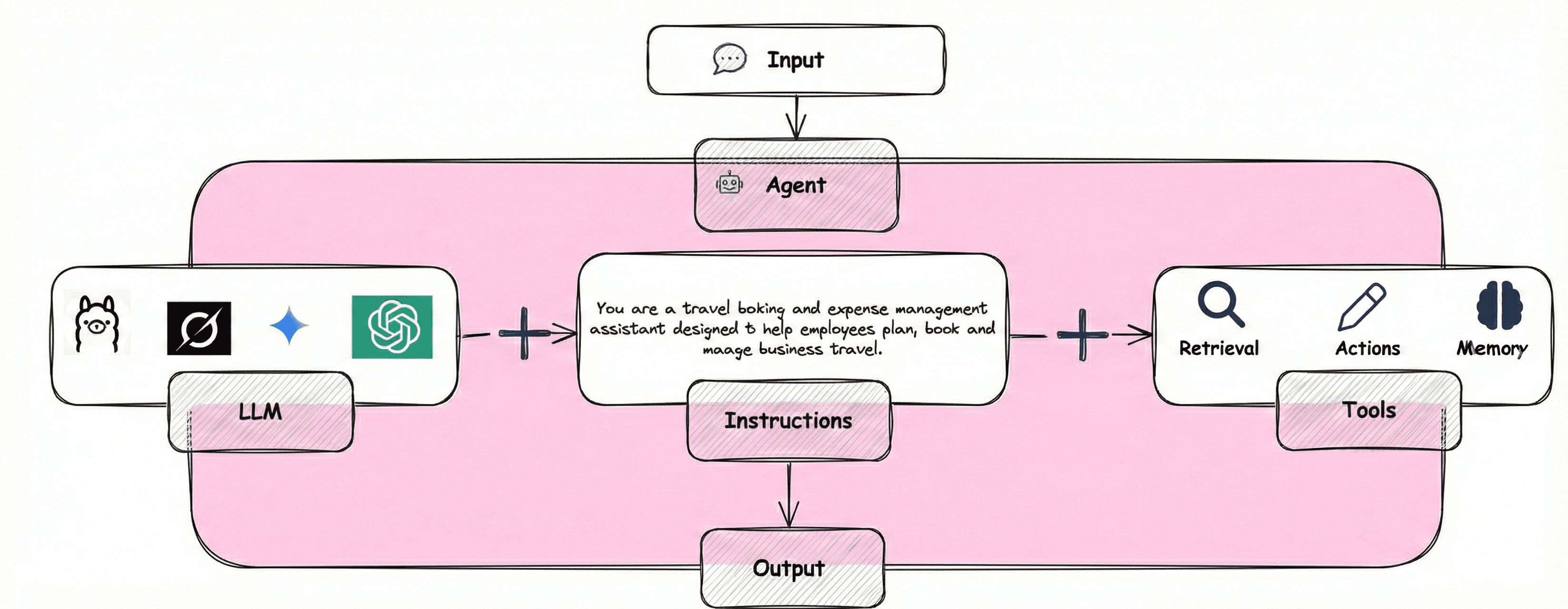
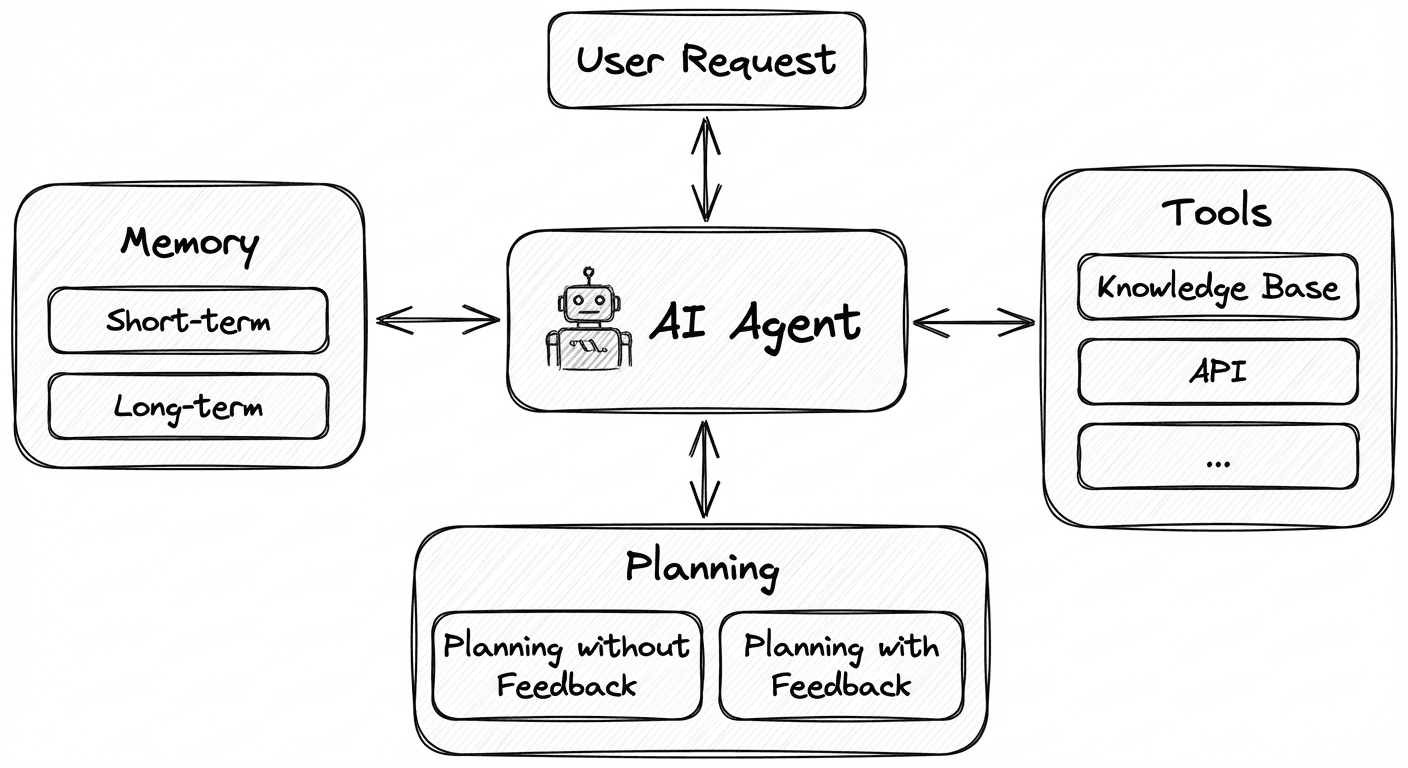
Modern AI agents are built on a modular architecture that allows them to function in dynamic environments.
- Perception/Sensors: Collecting raw data via APIs, web scraping, or sensors and converting it into structured information.
- Reasoning/Decision Engine: Using LLMs or planning algorithms to evaluate options and determine the optimal path.
- Memory/Knowledge Base: * Short-term: Contextual data within the current task.
- Long-term: Stored in Vector Databases (RAG) to retrieve historical data and external knowledge.
- Action & Learning Modules: * Tools: The "hands" of the agent (APIs, code execution).
- Learning Mechanism: Updates the agent's strategy based on reinforcement learning or user feedback.
4. How AI Agents Operate (The Agentic Loop)
The workflow follows a continuous cycle:
Receive Goal & Context: The user provides a high-level objective (e.g., "Summarize last week's sales and email the report").
Perception: The agent gathers data from CRM systems, logs, or web searches to understand the current state.
Reasoning & Planning: The agent breaks the goal into sub-tasks (Query System A -> Filter Data -> Generate Report -> Send Email).
Execution: The agent calls the necessary APIs or executes code.
Evaluation & Learning: The agent checks the result against the goal. If it fails, it "re-plans" and tries a different approach, storing the experience in its long-term memory.
5. Practical Industry Applications
- Finance & Banking: Automating eKYC, fraud detection, and personalized financial advice.
- Logistics & Manufacturing: Predictive maintenance, warehouse optimization, and autonomous supply chain coordination.
- E-commerce: Deeply personalized shopping assistants that handle everything from product discovery to returns and refunds.
- Healthcare: Analyzing medical records, assisting in radiology, and managing patient follow-ups autonomously.
- Public Sector: 24/7 virtual assistants for administrative procedures, reducing manual document retrieval by up to 60%.
6. Challenges and Future Trends
The Risks:
- Data Privacy: Agents require deep access to sensitive data; strict encryption and "least privilege" access are mandatory.
- Ethics & Bias: Agents can inherit biases from training data, leading to unfair decisions in areas like credit scoring.
- Technical Complexity: Integrating agents with legacy systems (APIs without documentation) remains a hurdle.
The Future:
- Multi-Agent Systems (MAS): Entire "digital departments" where specialized agents (e.g., Accountant Agent, Marketer Agent) collaborate.
- Ubiquitous Multi-modality: Agents that can "see" (computer vision), "hear," and "speak" to interact with the physical and digital world.
- The "Computer Use" Era: Agents moving beyond APIs to interact directly with Graphical User Interfaces (GUIs) just like humans do.
Conclusion
AI Agents represent a fundamental shift from AI as a "consultant" to AI as a "worker." While they offer immense productivity gains, the 2026 landscape emphasizes the need for Human-in-the-loop governance to ensure ethical and strategic alignment.